Categories
News

The Factory Comes to the Matter: Autarcycle Delivers Its First Micro-Factory

First sale. First delivery. TRL 9.

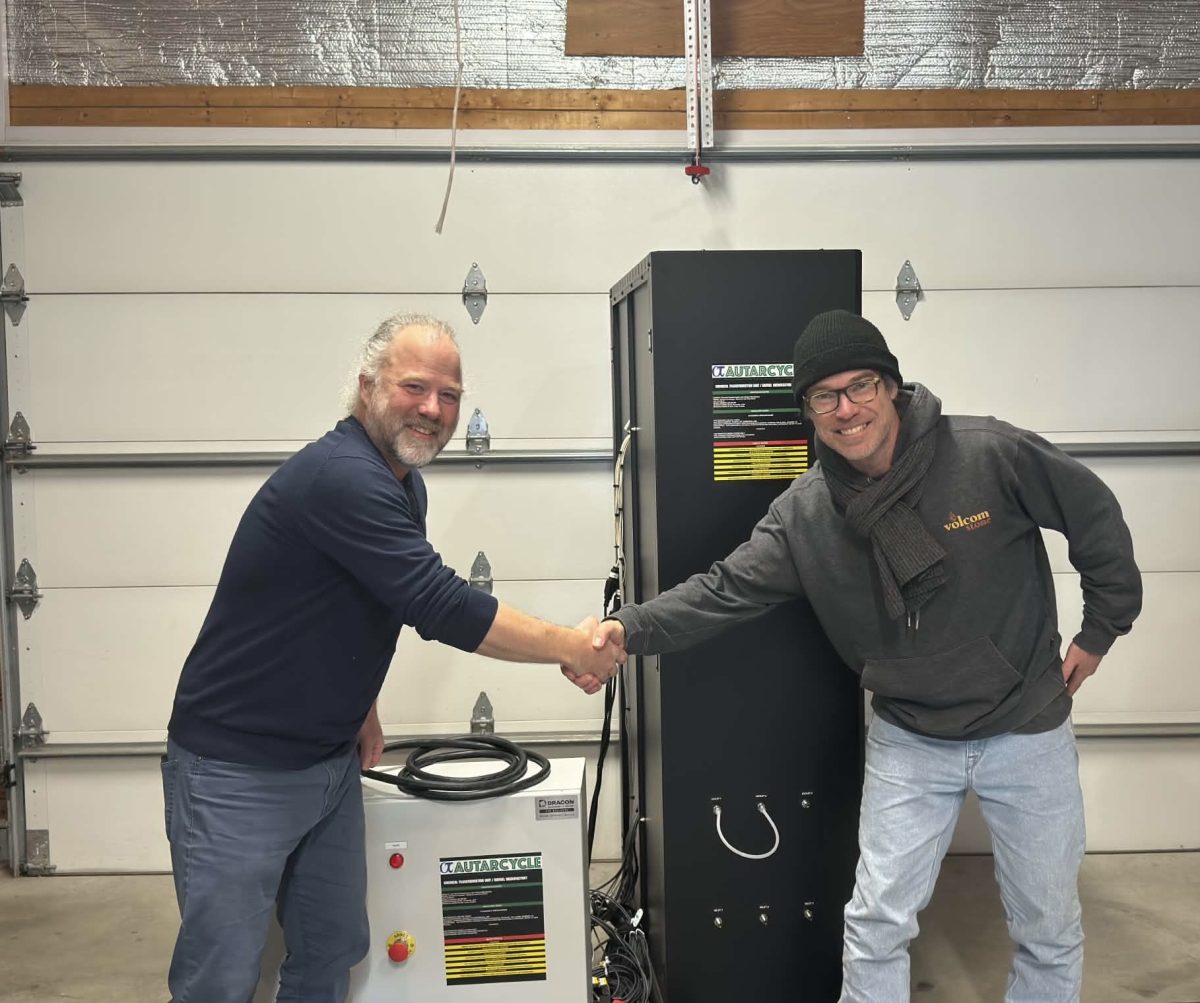
Seventeen years after its founding, Autarcycle has delivered its first micro-factory to SCF Pharma. Decentralized, automated and sovereign chemistry is no longer a promise: it has been delivered.

A 17-year marathon

  • 2009: company founded, TRL 1
  • 2015: TRL 4
  • 2025: TRL 7
  • 2026: TRL 9, first sale and first delivery

In our 2026 Project Advancement Statement, we announced reaching TRL 7 and sought partners to drive the commercial deployment of our units. This is what came next.

One unit, two missions

Built for Research Use Only (RUO), this automated chemical transformation unit demonstrates TRL 9. It will be used both to produce biofuel and to develop new chemical transformations of biomass-derived components, notably monoacylglycerols (MAGs).

Discover the CTU-RUO, its capabilities and functions

See the technology in action: Biofuel at your finger tips

A new kind of sovereignty

Our conviction remains the same: move the factory to the matter, rather than the matter to the factory. The petroleum age centralized power; the bio-resource age can redistribute it. Every community should be able to transform its own resources, rather than export its natural wealth only to import a fossil imitation of it.

And this is only the beginning. Our roadmap leads to dialkyl carbonates and primary alcohols, green synthons set to replace petrochemical products.

Let’s build what comes next, together

Partners, investors, visionaries and builders: let’s talk about your project.

Alain Rouillard, Ph.D., Pharm.D., Founder of Autarcycle Inc.

Categories
News

2026 PROJECT ADVANCEMENT STATEMENT

Building Industrial Sovereignty for the Post-Oil Era

Innovation is a marathon. At Autarcycle, our persistence is now bearing fruit. After years of development, we have reached a historic milestone: the successful transition from TRL 1 toTRL 7 for our automated biofuel micro-refinery technology.

This is concrete proof that our vision of decentralized, automated, and sovereign chemistry is no longer just a concept, it is an operational reality.

An IP Portfolio for Tomorrow’s Chemistry

Beyond a single machine, we have built a robust Intellectual Property (IP) portfolio. Our automated processes allow chemical transformation to be relocated directly to where it is needed, breaking the dependence on centralized fossil-fuel infrastructures. This engineering is rooted in the 12 Principles of Green Chemistry, ensuring optimal atomic efficiency and a minimal environmental footprint.

A Versatile Platform for Strategic Markets:

• Agriculture & Energy Sovereignty (TRL 7 Solution):This model leverages on-farm grain pressing to provide both oil and press cake (livestock feed). Our micro-refinery then transforms this oil into biofuel using dialkyl carbonate. This ready-to-deploy solution offers increased autonomy and strengthens energy resilience within local territories.

• Hydrometallurgy & Battery Recycling: The mining and extractive industry is a massive consumer of fuel. Our technology addresses a dual challenge: it enables on-site production of both the biofuel required for operations and the hydrometallurgical diluents indispensable for mineral extraction and battery recycling. This dual production secures the strategic metal value chain locally while drastically reducing logistical costs.

• Expanding the Chemical Suite (R&D Roadmap): We are capitalizing on our technological lead to develop future units dedicated to the production of dialkyl carbonates and primary alcohols, the pillars of tomorrow’s chemistry:

◦ Towards Process Self-Sufficiency: Eventually, on-site primary alcohol production will serve as a precursor for synthesizing our own dialkyl carbonates.

This vertical integration aims to eliminate the need for external reagents for transforming oil into fuel.

◦ Green Synthons & Commodity Products: These molecules, produced on farms or industrial sites, will act as building blocks for a multitude of products currently derived from petrochemistry: polyurethanes, biodegradable cleaners,pharmaceuticals, and battery electrolytes diluents. This model maximizes profits through the decentralized manufacturing of commodity products.

A Call to Visionaries and Builders The success of our TRL 7 milestone in biofuels significantly de-risks our overall technology. We are now seeking strategic partners and investors to propel the commercial deployment of our current units and finalize the development of our green synthons.

By transforming every biomass production point or industrial site into a future sovereign manufacturing center, we are building tomorrow’s independence.

I invite you to contact us to start the conversation.

The adventure is only beginning.

Alain Rouillard, Ph.D., Pharm.D., Founder of Autarcycle Inc.

Categories
News

Moving the Factory to the Matter

Look at oilseeds and plant crops in general.

They are masterpieces of solar engineering.

Yet, in our current industrial system,

they are the symbol of a broken economy.

Today, a farmer harvests his crops 

and sells them for a fraction of their value

to centralized processing and distribution plants

located hundreds of miles away.

That is when the absurdity begins.

That same farmer must 

buy the meal to feed his livestock,

the fuel to run his tractor,

the fertilizers to feed his land 

and all the materials necessary for his business.

All of this could be produced from the very crops he grew.

But the transportation costs to processing plants,

the industrial margins and the associated carbon emissions

make competition impossible against petroleum products.

We are forcing our farmers to export their natural wealth

only to then import a fossil imitation of it.

It is an economic and ecological dead end.

What if we stopped moving the matter to the factory,

and started moving the factory to the matter?

What if we replaced the oil barrel with the local harvest?

We are here to build a disruption:

the automated and decentralized micro-factory.

Imagine a modular unit, the size of a shipping container,

dropped right at the edge of the field.

It doesn’t just “process”;

it reintegrates the entire value chain.

It separates the biomass into three vital streams, 

keeping the value where it belongs:

First, the Proteins. 

The seeds are pressed on-site. 

The high-protein meal remains on the farm to feed the cattle. 

The farmer keeps his resources.

Second, the Lipids. 

The oil is immediately converted into biofuel 

for direct use on the farm. 

The farm becomes its own gas station.

Third, the Sugars and Cellulose. 

We recover the “waste”

the stalks, the husks, the residues 

and we unlock the carbon.

To build a modern world without petrol,

we need versatile chemical synthons

that allow access to bio-based replacement products.

In our micro-units, we will produce primary alcohols:

Methanol (C1), Ethanol (C2), Propanol (C3) and Butanol (C4),

These are the primary liquid building blocks.

This gives access, among others, to dialkyl carbonates,

the absolute reference for green solvents.

We use them to create high-performance biofuels 

that outperform traditional diesel,

high-value polyurethane for insulation,

specialized hydrometallurgical solvents for extraction,

and beyond…

We aren’t just farming;

we are performing high-end molecular engineering in a box.

We are replacing the petroleum refinery with a biological one.

Because automation has finally broken the barrier of scale,

our software pilots these complex liquid-phase reactions in a container.

This shifts the balance of power.

We move from a “top-down” extractive economy dependent on petrol,

to a “bottom-up” generative economy dependent on the sun.

By removing the middlemen 

and the thousands of miles of transport,

we finally make bio-resources more competitive than petrol.

We don’t just match the price of fuel;

we beat the system that supports it.

Imagine a global network of these cells.

A world without pipelines.

A world where economic resilience is grown, not imported.

The petroleum age centralized power.

The bio-resource age will redistribute it.

We are not just talking about a new machine,

but about a new type of sovereignty.

A world where every community has the tools

to turn their land into their future.

The future is not about gigantism, 

it is about integration.

Feeding the herd with the meal.

Powering the machines with ultra-high-performance biofuels 

derived from vegetable oil or tallow.

And building the world 

with primary alcohols derived from plants.

It is all right here,

under our feet.

We just needed the right box

to unlock it.